Wednesday, December 3, 2014

Food Production and Farming in Turkey: Post #12

Food Production and Farming in Turkey
Christina Martin (Group 4 Turkey)

  Turkey Agriculture 1306         
Figure 1: Wheat field in Turkey's agriculture region (Intensive Farming)
            Food and food production are the most basic needs of everyone on Earth. There are few different ways to farm and produce food. Extensive farming, as defined by The BBC, is “where a relatively small amount of produce is generated from a large area of farmland.” Extensive farming is more likely to use traditional farming methods and go organic with little to no pesticides used. Intensive farming, as defined by The BBC, is “where a large amount of produce is generated from a relatively small area of land.” Intensive farming will need more help, such as multiple workers and more use of machinery and technology, and it will also need more money to make it successful to produce food in bulk quantities. Intensive farming is also more likely to use pesticides and GMO’s (genetically modified organisms) to help mass produce more food. Intensive Farming uses small areas of land over and over again, damaging and using all the nutrients in the soil. This means intensive farmers have to use more nutrient rich land more frequently than Extensive farming, wasting soil and places for more food to be planted.   Extensive farming is cheaper to maintain and does not need as many workers or as much work to produce select or low quantities of food
            The industrial food production is much like intensive farming, it is to create and supply food in big bulks and quantities, like the mass production of food for large, popular fast food companies. These foods are more likely to be processed packaged ready-to-eat-meals. The traditional food production is much like extensive farming and focuses on the smaller quantities with fewer pesticides, GMOs, or other chemicals. Like with intensive farming, industrial food production will be more expensive to maintain and will need more money and workers to keeps it successfully mass-producing food.
 
Figure 2: Turkish Farmer           
            The economy in Turkey has had strong growth partly fueled by agriculture beginning in the, among other things, such as tourism, trade, manufacturing, and foreign investments. Turkey is considered to be one of the leading countries in the world when it comes to agriculture and food because of its climate and geological conditions. Turkey is one of the largest exporters of food/agricultural products in Eastern Europe, the Middle East, and North Africa. The agriculture industry accounts for 25-32 percent of the employment in the country. Most farming that happens in Turkey is intensive farming because there is a bigger demand for packaged, processed, ready-to-eat-meals, and frozen food. Turkey is the world’s leader when it comes to the production of dried apricots, sultanas raisins, hazelnuts, and dried figs. Turkey also has a large amount of dairy farmers that are produced to the citizens by both industrial and traditional food production. 

Turkey earns $1.69 billion through hazelnut exportsTurkish Sultana Raisins
Figure 3 & 4: Examples of two of Turkeys most exported items  
      There are problems arising with industrial food production and intensive farming because it leaves little land, money, natural resources, and other needed resources for traditional/organic farming. However, even with these problems there is a significant rise in organic and traditional farming. Many people in Turkey are beginning to question the methods used in intensive farming and industrial food production and are wanting to help more, be more informed on what is in the food they are eating, and to provide overall healthier foods for its citizens. 

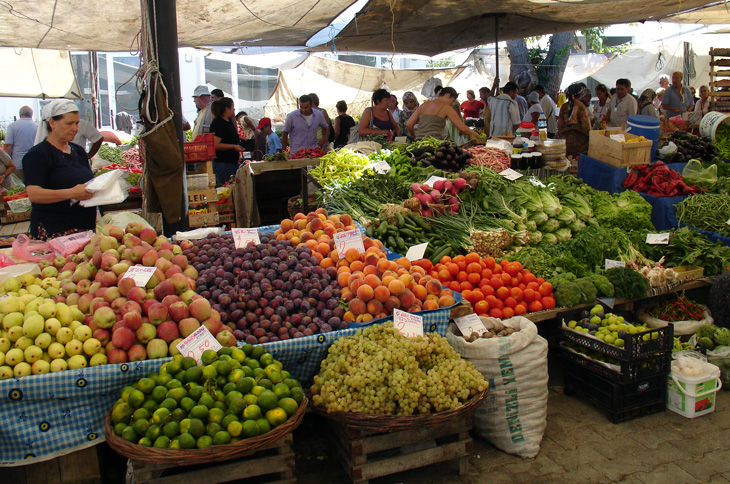
 Kocaeli-market-1
 Figure 5: Turkish woman selling fresh produce at a farmers market in Kocaeli, Turkey.


Works Cited
Definitions of Intensive and Extensive farming
Definitions of Traditional and Industrial Food Production
Exports From Turkey
Exports and Agriculture Employment in Turkey
http://www.allaboutturkey.com/agriculture.htm December 1, 2014

Farming Methods In Turkey

Figures Work Cited
Figure 1 
http://www.nationsencyclopedia.com/Asia-and-Oceania/Turkey-AGRICULTURE.html December 1, 2014
Figure 2 
https://www.flickr.com/photos/wefwef/7513563396/ December 1, 2014
Figure 3
Figure 4

Figure 5 
http://www.theperfectpantry.com/2012/02/market-to-pantry-27.html December 1, 2014

Culture and Turkey: Post #7


Culture and Turkey: Post #7

Culture is defined by our textbook as, “learned and shared behavior by a group of people that gives them a distinct ‘way of life.’ ”[1] It consists of a shared history of knowledge and traditions that gives a group of people a sense of unity and identity, and as such its importance to a nation’s coherence can not be stressed enough.
Turkey has a unique cultural landscape, due to its intensely varied physical terrain, which ranges from mountains and steppes to lush coastlines and inhospitable desserts. Due to its geographical terrain, Turkey has had a long history of farming and pastoralism, but due to increasing globalization it has become an increasingly modern nation, with now nearly 70% of its population living in urban areas. [2]

Figure 1. A map showing Turkey when a part of the Ottoman Empire.

Cultural imperialism, or “the active promotion of one cultural system at the expense of another”,[3]  is most certainly not an unknown concept to the country of Turkey. The most famous example of cultural imperialism would be Turkey being a part of the Ottoman Empire from 1299 to 1923. After the more than 600 years of cultural indoctrination that entailed, Turkey would become an independent state, but still heavily influenced by Ottoman rule, most visibly in their adherence to the Islamic religion.
 Figure 2. Mustafa Kemal Ataturk, founder of of the Republic of Turkey.

            Concerning the oppositional force against cultural imperialism, known as cultural nationalism, Turkey had an especially potent form of it following its national independence. Kemalism was created by the founder of the Republic of Turkey, Mustafa Kemal Ataturk. It was intended to give the people a voice through a parliament, and stressed liberalism and democracy, but eventually this potentially promising creed was defeated by the rise of fascism, as well as adherence to Ottomanism.[4]
            With cultural syncretism or hybridization being a amalgamation of two cultures to create a new one, the most obvious example of such in Turkey would be their many customs and traditions they have taken from Ottoman rule. Not the least of which most definitive imports being the adoption of the Islamic faith, which can touch every part of day to day life in Turkey.


Works Cited
Ahmad, Feroz. The Making of Modern Turkey. London: Routledge, 1993. 61. Print.
Rowntree, Lester. Globalization and Diversity: Geography of a Changing World. 4th ed.   Upper Saddle River, NJ: Pearson Prentice Hall, 2014. G-3. Print.

"Turkey: People and Society." Encyclopedia of Earth. Web. 3 Dec. 2014. <http://www.eoearth.org/view/article/172904/>.

Figure 1.  Turkey Map. Digital image. Allaboutturkey.com. N.p., n.d. Web. 3 Dec. 2014. <http://www.allaboutturkey.com/img/ottoman-empire-1580.gif>.
Figure 2.  Mustafa Kemal Ataturk. Digital image. Turkeytourkey.com. N.p., 2012. Web. 3 Dec. 2014. <http://www.turkeytourkey.com/upload/inquiry/blog/Mustafa_Kemal_Ataturk_.jpg>.


[1] Rowntree, Lester. Globalization and Diversity: Geography of a Changing World. 4th ed. Upper Saddle River, NJ: Pearson Prentice Hall, 2014. G-3.
[2] "Turkey: People and Society." Encyclopedia of Earth. Web.
[3] Rowntree, 27.
[4] Ahmad, Feroz. The Making of Modern Turkey. London: Routledge, 1993. 61.

Globalization's Impact on Turkey's Environment: Post #9


Globalization’s Impact on Turkey’s Environment Post #9

As globalization increases, humans are not the only things living on the earth’s surface that are affected by globalization. The earth itself is affected as well as populations expand and land is cleared to accommodate the ever-increasing numbers and needs of man. The vast jungles of the Amazon are often what first come to mind, as the forests are burned and cleared in the process of grassification in order to give the inhabitants of South America and other surrounding countries more room for farming and growth. Of course practices such as these can be viewed as immediately positive for mankind, but in the long run can be detrimental for the environment.
Trade agreements also impact on the earth’s environment due to the increased level of economic development and construction which lead to increased urbanization, often at a brisk pace that can also be damaging to the surrounding environment. When major companies, especially large and foreign companies, make a successful trade agreement with a less-developed nation, any potential damage to the latter’s natural surroundings or ecosystem due to pollution is not among their first concerns.


Figure 1. An oil tanker off the shores of Turkey.


After World War II, Turkey wished to become more modern, and it saw capitalism and free trade with the western world, (particularly Europe and America) as the way to prosperity. They endeavored to cultivate European interest in their natural resources, and were prepared to pay any price for Western investment, even if it meant alienating their political allies, or damaging their own country. [1] Compared to its immediate neighbors, Turkey has had a somewhat less tumultuous history of trade relations, but as it is a considerably developed and economically functional country, it is not without its problems. The natural resource that Turkey’s foreign investors are the most interested in is oil, and this is what has proven to be the most harmful to Turkey’s environment. Among many of the risks that are associated with oil production are oil spills from oil tanker accidents, and Turkey received international attention with the infamous Nassia catastrophe in 1993, which caused considerable marine pollution.[2]  It must be hoped that in future Turkey will use more green energy and take more precautions with its oil industry.


Figure 2. A map showing Turkey's rich natural resources, including oil.


Figure 3. A graph showing Turkey's oil production.


Works Cited
Ahmad, Feroz. The Making of Modern Turkey. London: Routledge, 1993. 119. Print.
"U.S. Energy Information Administration - EIA - Independent Statistics and Analysis." Turkey: Environmental Issues. 1 Mar. 2000. Web. 3 Dec. 2014. <http://www.nuce.boun.edu.tr/turkey.html>.


Figure 1.  Turkish Oil Tanker. Digital image. Seanews.com. N.p., n.d. Web. 3 Dec. 2014.
Figure 2.  Turkey's Natural Resources. Digital image. Www.lib.texas.edu. N.p., n.d. Web. 3 Dec. 2014.
Figure 3.  Turkey's Oil Production. Digital image. Eia.gov. N.p., 2012. Web. 3 Dec. 2014.


[1] Ahmad, Feroz. The Making of Modern Turkey. London: Routledge, 1993. 119
[2] U.S. Energy Information Administration - EIA - Independent Statistics and Analysis." Turkey: Environmental Issues. 1 Mar. 2000. Web. 3 Dec. 2014. <http://www.nuce.boun.edu.tr/turkey.html>.

Tuesday, December 2, 2014

Problems Associated with Food Production and Turkey's Agricultural Impact. Post: #11


Food is vital to survival, yet for many people it is a struggle to simple produce it. A rising population demands more food, but it also needs more housing. Urbanization has caused many fertile lots of land to become shopping malls and apartment complexes. More and more crops are being used, not as food, but as fuels like ethanol. More and more people are adopting a Western diet, which focuses on meat as the main portion of a meal. This is an issue because raising cattle requires a massive amount of resources. The BBC reports that it takes up to twenty-five times as much land to produce the same amount of beef as wheat. That does not include the water used to keep the animals hydrated, or the moral issues with factory farms. Food scarcity is a major concern for many countries, but others have an overabundance of food.

Figure 1: A Turkish farmer in the fields.
Turkey has a wonderful climate that allows for a wide variety of plants to thrive. According to invest.gov.tr, Turkey is able to support 95% of plant species in Europe. Many locals take advantage of this and about a quarter of the population work in agriculture.[1] Turkey is bursting at the seams with food. Not only is it one of the most agriculturally self-sufficient countries in the region, it is also one of the largest exports food in Europe.

Figure 2:Turkish farmers selling their bountiful harvest.
Turkey dominates the export of figs, hazelnuts, and apricots. Turkey also exports many traditional dished and items. Turkish artisan cheese is renowned in the area. Kefir (a cultured dairy product similar to yogurt) is so loved that its name derives from the Turkish word for "feeling good". [1] Turkey produces many grains and has become a leader in baked good with traditional beads. This nation is a major player in agriculture, and all predictions expect its food production and exports to increase.


Works Cited


"Agriculture and Food" Agriculture and Food - Invest in Turkey. Web. 3 Dec. 2014. <http://www.invest.gov.tr/en-US/sectors/Pages/Agriculture.aspx>.

"Global Food Supply Is a Growing Problem." The Telegraph. Telegraph Media Group, 8 June 2008. Web. 3 Dec. 2014. <http://www.telegraph.co.uk/finance/economics/2791256/Global-food-supply-is-a-growing-problem.html>Rowntree, Lester. Globalization and Diversity: Geography of a Changing World. 2nd ed. Upper Saddle River, NJ: Pearson Prentice Hall, 2008.

Figures


Figure 1: A Turkish Farmer in the Fields. Photograph. http://www.businessturkeytoday.com/wp-content/uploads/2012/03/TURKISH_FARMER.jpg. 2014.

Figure 2: Turkish Farmers Selling Their Bountiful Harvest. Photograph. Http://www.bodrumpeninsulatravelguide.co.uk/wp-content/uploads/2012/10/Yalikavak-Farmers-Market.jpg. 2012.

[1] Howard, Douglas A. The History of Turkey. Westport, Conn.: Greenwood, 2001. Print.